


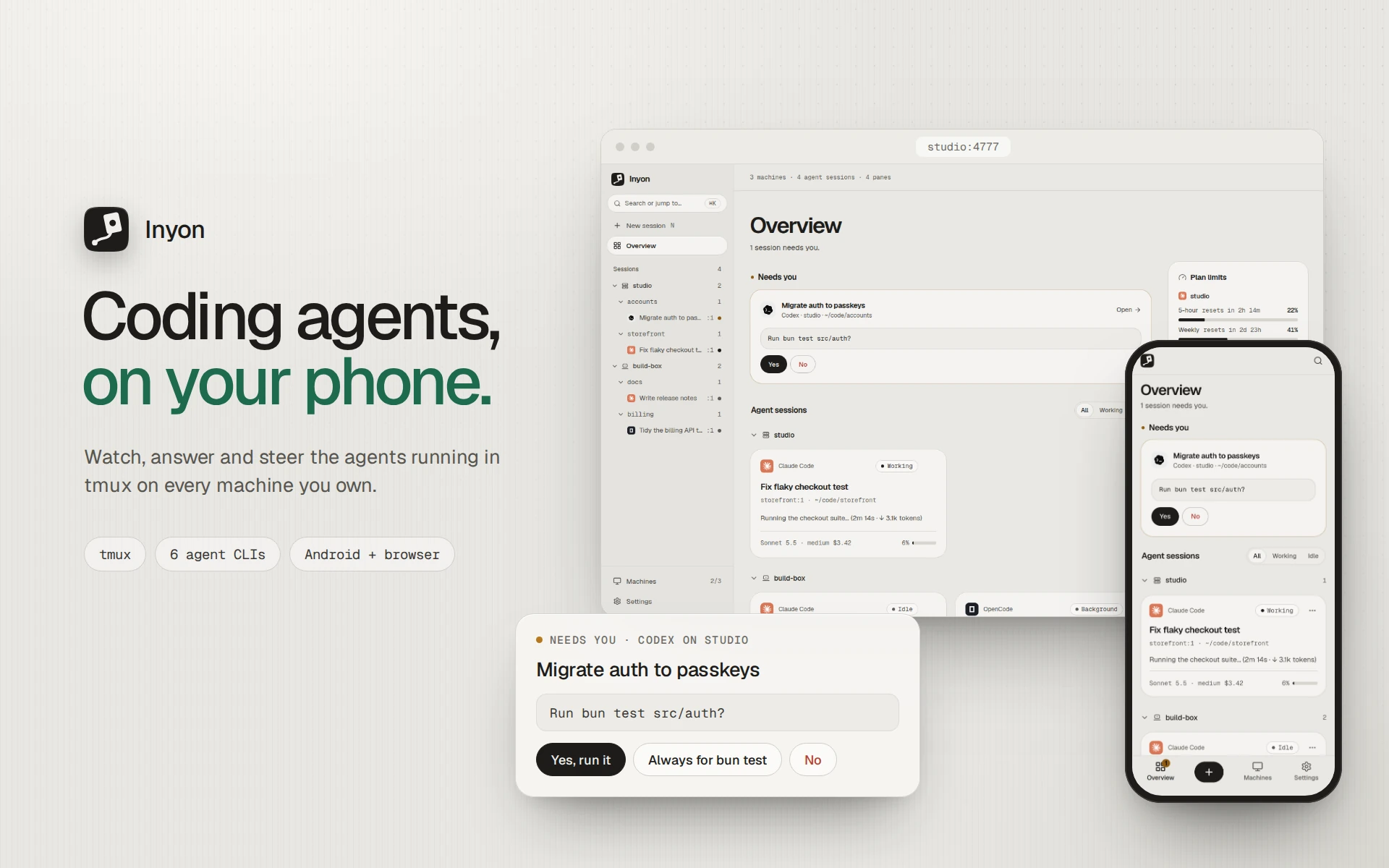
Inyon lets me watch, answer and steer the coding agents running in tmux on all my machines, from my phone or any browser. It works with Claude Code, Codex, Gemini CLI, OpenCode, GitHub Copilot and Antigravity, and it's open source, at version 0.17.3 after 28 releases.
What it is
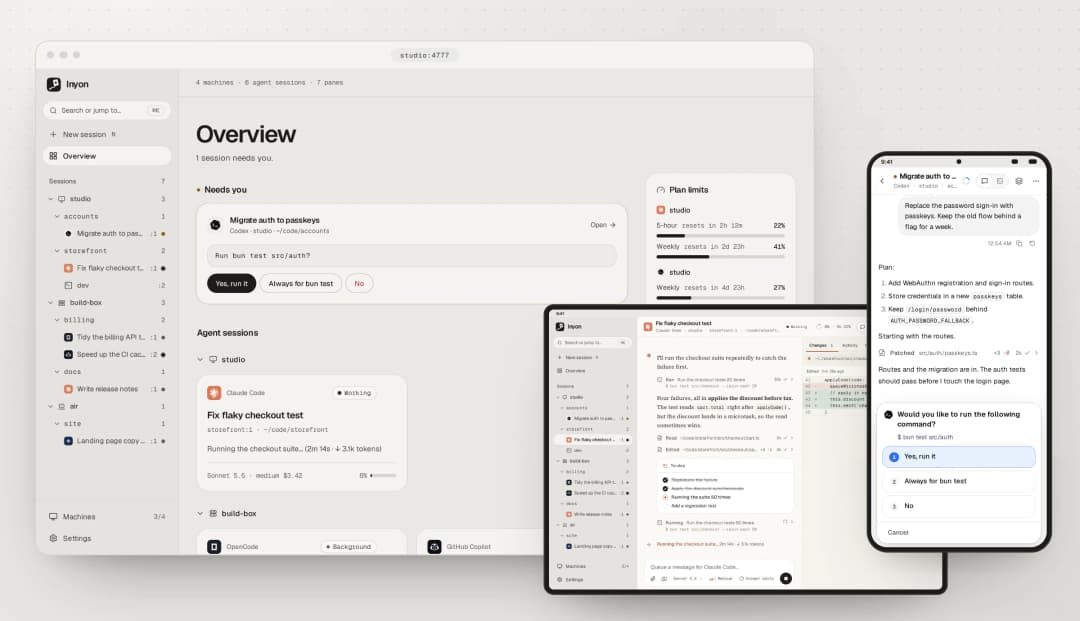

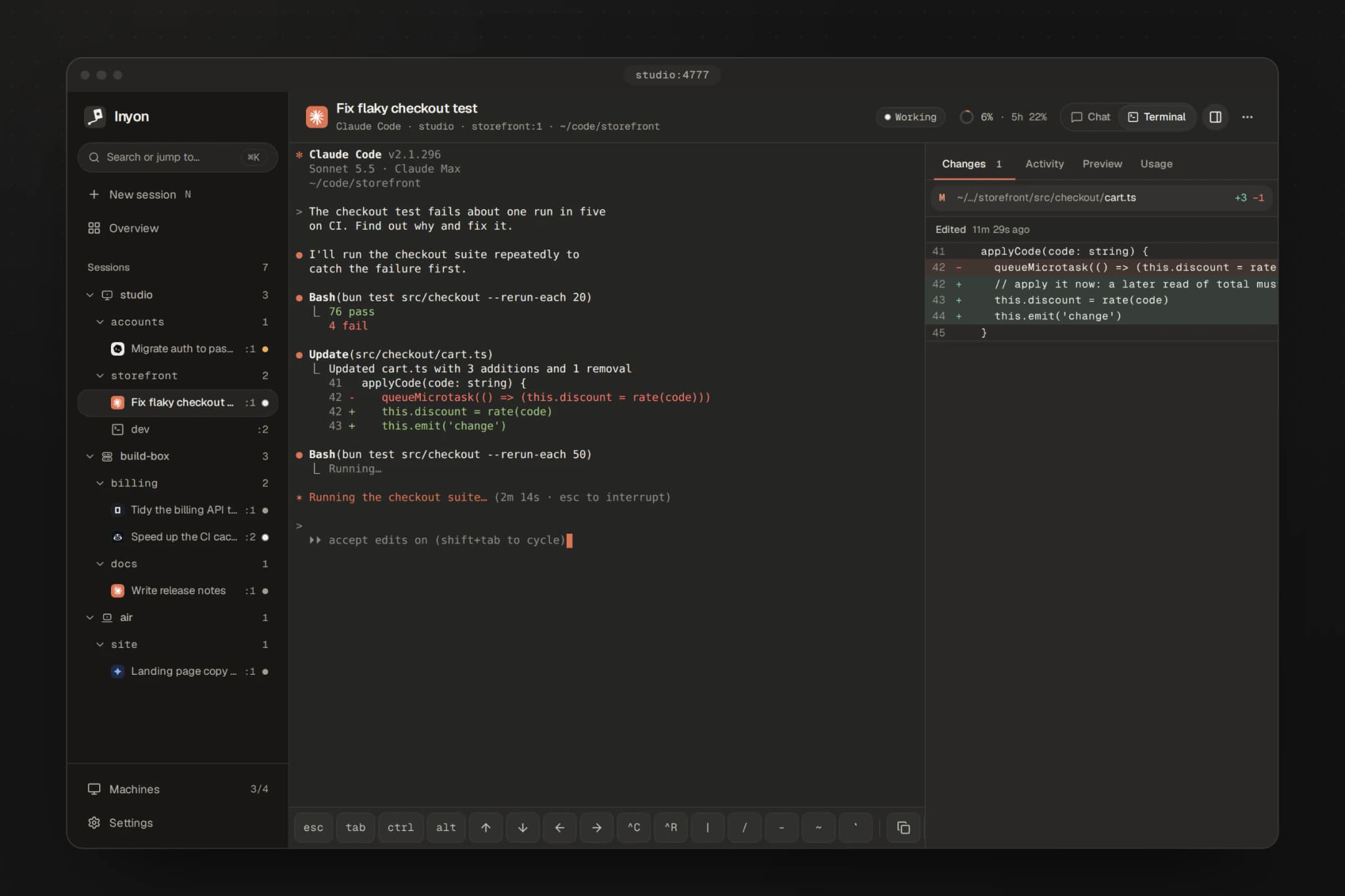

A remote control for agents you already run. Each agent keeps working in its tmux pane on its own machine. Inyon reads what it's doing and shows it as a chat, with the model, context, cost and plan limits beside it. When an agent asks something, the answers arrive as buttons.
Nothing changes at the keyboard. I can walk away from the laptop, answer from my phone, and sit back down to the same terminal.
Why I built it
I run agents on a laptop, a home server and a company server, and each is signed in to a different account. On the company machine I only have the CLI. The built-in remote features follow one account at a time, so moving between machines meant moving between accounts.
Inyon never signs in to anything. It drives the CLI that's already running, so every machine keeps its own account, subscription or API key.
What I built
I designed and built all of it alone: the hub, the web app, the Android app and the inyon program that runs on each computer.
The hub (Bun, TypeScript) reads tmux through a read-only control client, plus each agent's own records: Claude Code and Codex session files, Gemini CLI's chat recordings, Copilot's event logs, Antigravity's transcripts and OpenCode's local server. Answers go back with
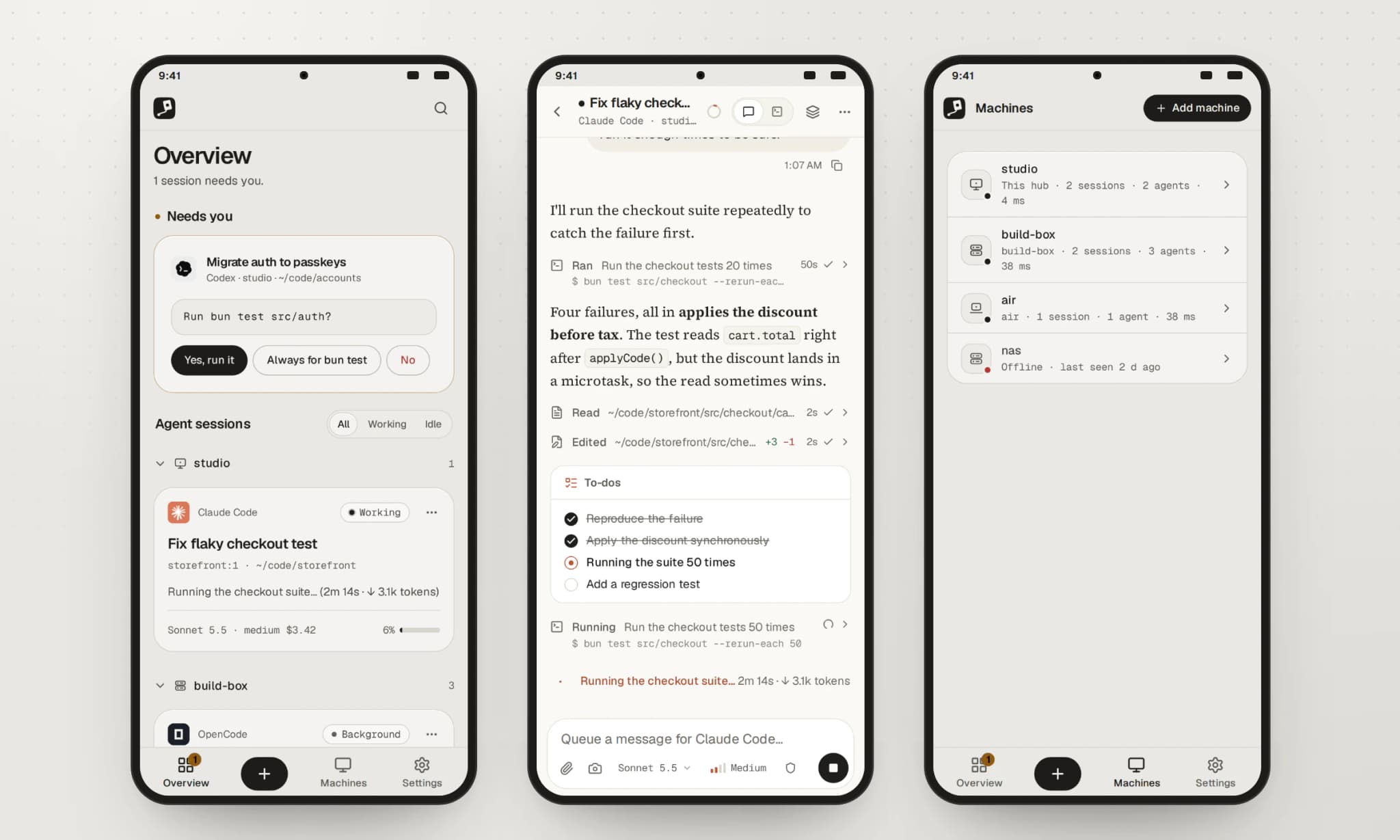
tmux send-keys, exactly as if I'd typed them.The app (React, Vite) shows each session as a chat with tool calls, diffs, plans and to-dos, and the real terminal one tap away. Inside a session it takes on that agent's colours and reply font; everywhere else it stays ink on silver.
The Android app (Capacitor with Kotlin plugins) runs the same core on the phone, so the phone is its own hub. It can also reach a bare server over SSH through ConnectBot's sshlib.
inyon is one compiled binary for Linux, macOS and Windows (through psmux). The install script checks it against the release's SHA256SUMS before it runs.

What was hard
Agents don't publish their questions. Each one draws its prompts differently, and the layout shifts between versions. So the hub reads the pane's screen with a parser per agent, tested against fixtures captured from real sessions. I wanted hooks for every agent, but Codex runs its hooks inside a background daemon where TMUX_PANE points at the wrong pane, so Codex stays on screen reading.

A laptop sits behind NAT, and I didn't want to host a server for anyone. inyon opens a free Cloudflare quick tunnel, signs its current address with its own key and publishes it with pkarr. The phone checks that signature, then the two run a Noise IK handshake, so the tunnel only ever carries ciphertext. The trade-off is that quick tunnels come with no uptime promise. On Tailscale, NetBird, ZeroTier or WireGuard, the Android app races that address against the tunnel and keeps whichever answers first.

Notifications had the same constraint. Browsers get standard Web Push: each computer encrypts the alert itself (RFC 8291) and sends it straight to the browser's push service. The Android app has no Firebase, so it keeps a small ongoing notification to stay connected. A fully closed Android app gets no alerts yet. That's the price of not running a push server.
Where it landed
Inyon is public on GitHub under the MIT licence. Every release ships checked binaries for five platforms and an Android APK, and the downloads page is at inyon.abhashchakraborty.tech.
- agent CLIs
- 6
- releases
- 27
- commits
- 313
- tests
- 1,093
Some parts are still young. The Gemini, OpenCode and Copilot readers are in beta, the iOS app isn't built, and on Windows the terminal shows only what's on screen, without scrollback.