

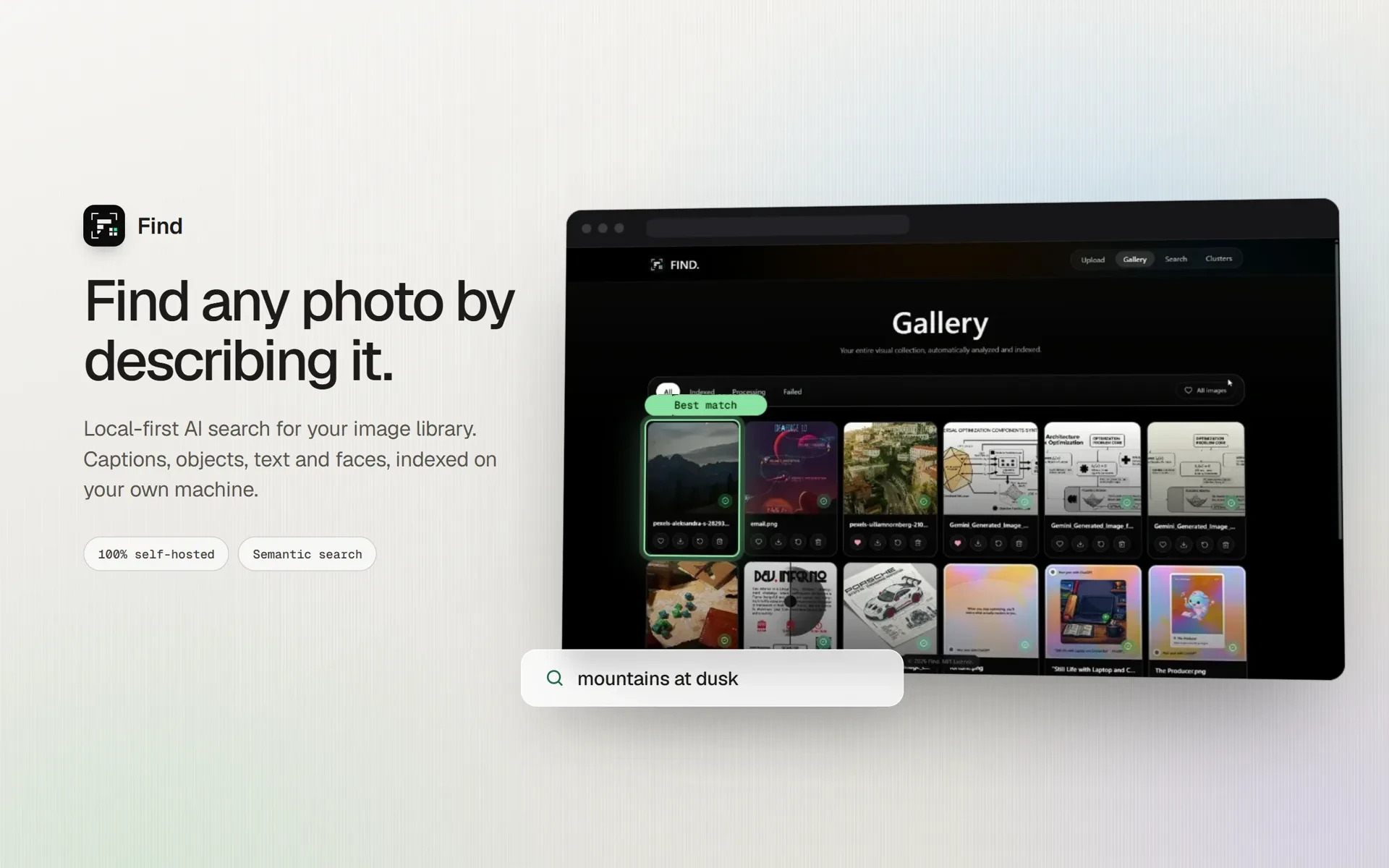
Find is a self-hosted photo library you search by describing a picture: it captions, tags, reads and groups your photos on your own machine, and nothing is uploaded anywhere. I started it in November 2025, opened it to GirlScript Summer of Code 2026, and released v1.1.3 in July 2026 with 77 contributors on GitHub and 131 pull requests merged from people other than me.
What it is
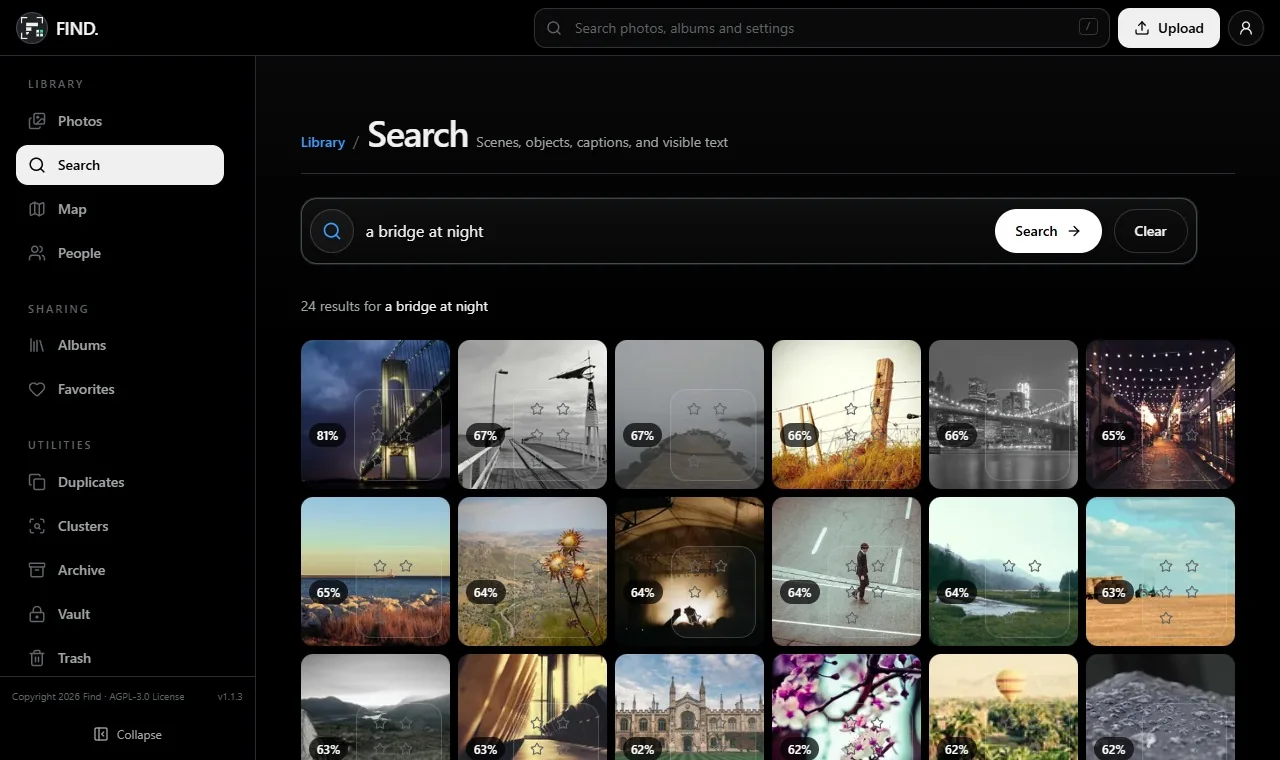
You drop in photos or a ZIP. A background worker writes a caption for each one, lists the objects in it, reads any text and finds faces. Then you type "a bridge at night" and the bridge comes back first.
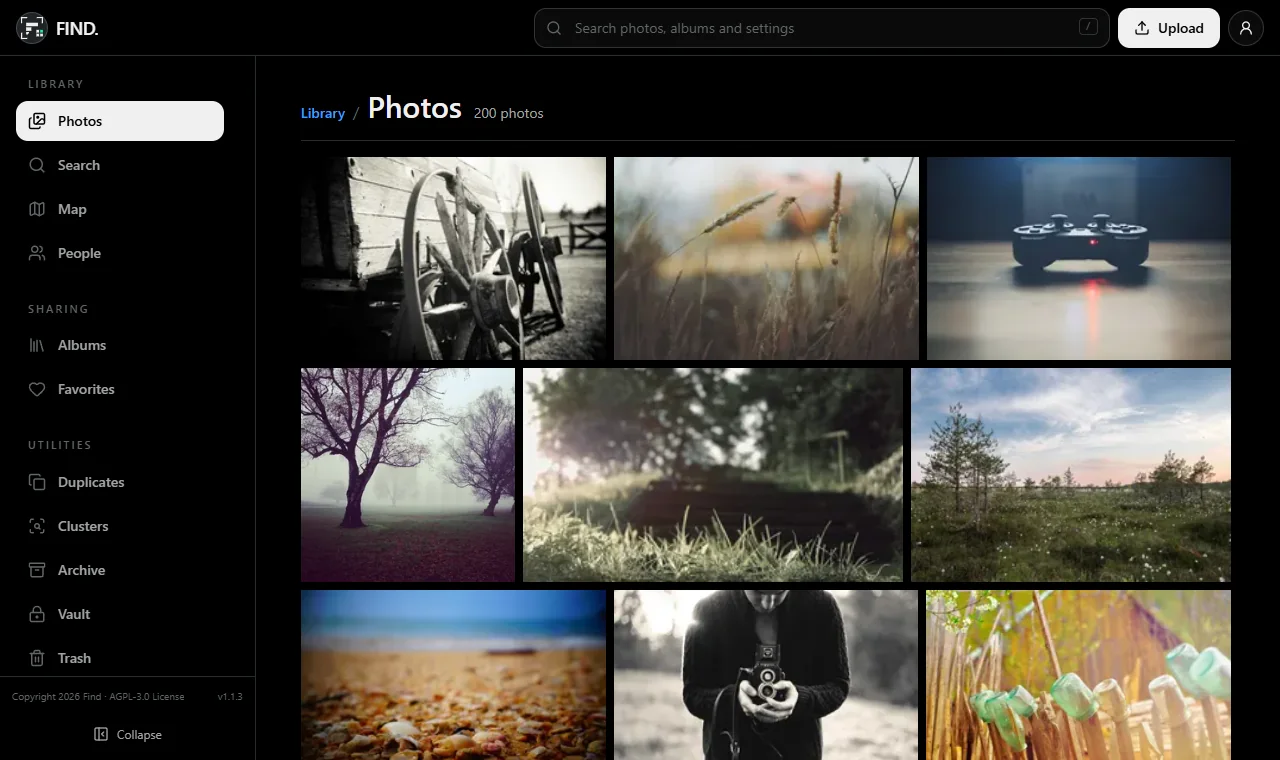
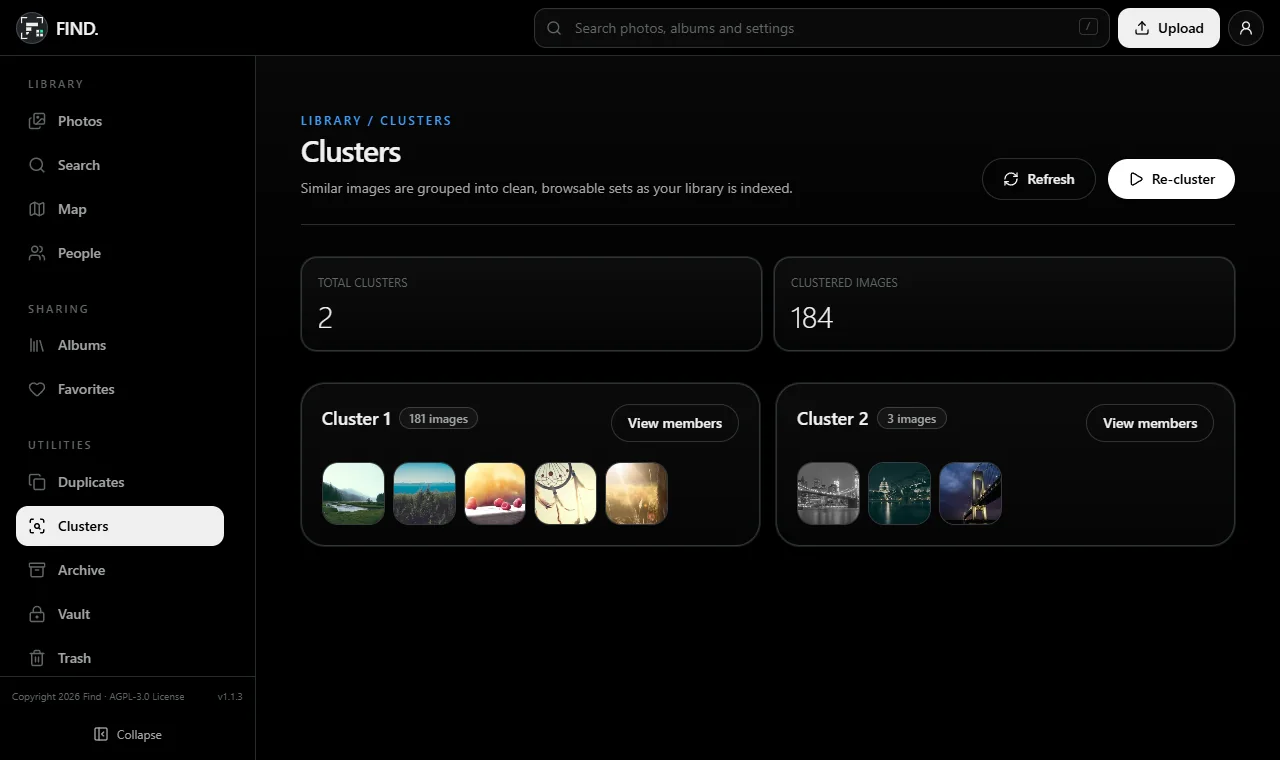
Around the search sits a full photo app with albums, people, a map and a locked vault. It ships as four Docker Compose profiles: NVIDIA GPU, plain CPU, a mock build for contributors and a build with no AI at all.
Why it mattered
Searching your own photos by what is in them usually means handing the whole library to a cloud service. I wanted that search with nothing leaving the box, on a laptop without a GPU. Remote inference is fail-closed: if it is selected and no adapter is installed, Find refuses rather than quietly sending a photo out.
What I built

I designed the architecture and wrote the ML pipeline. FastAPI keeps originals in MinIO and rows in PostgreSQL, and queues each photo on Redis for an RQ worker. The worker runs YOLO26 for objects, BLIP for the caption, PaddleOCR for text, InsightFace for faces and SigLIP for embeddings.
Each photo becomes one 768-number vector: a weighted average of the SigLIP embeddings of the image, its caption, its object labels and its OCR text. A query goes through the same model, pgvector returns the closest vectors by cosine similarity, and words that also appear in the caption, objects or OCR text add a small boost. That is why "receipt" finds receipts.
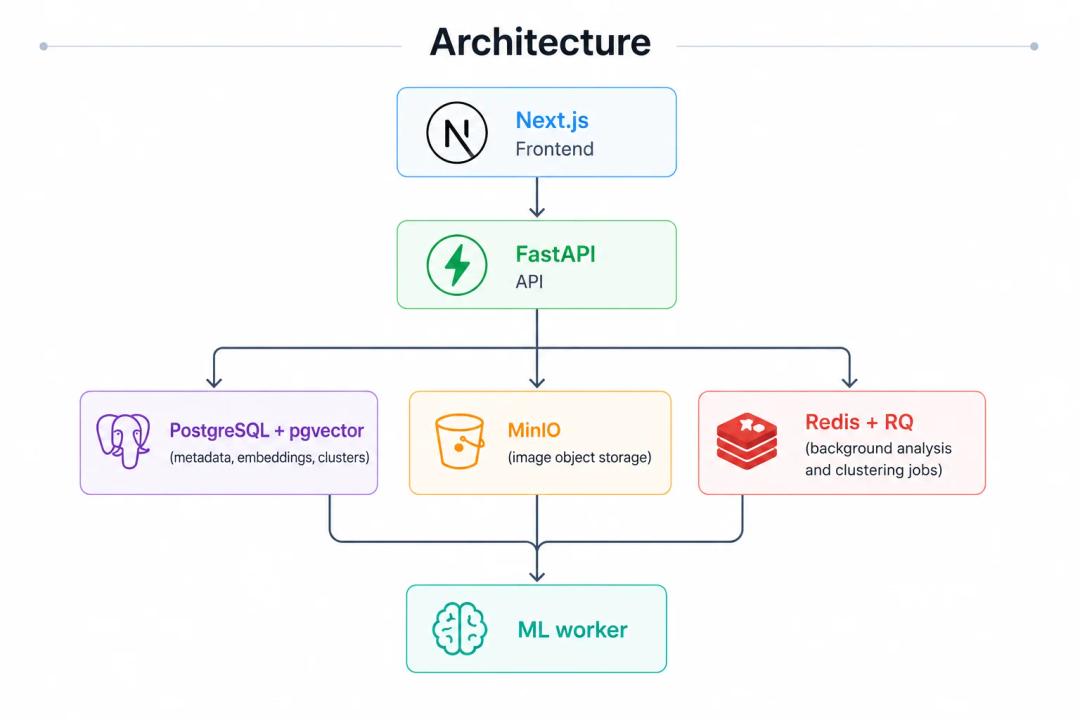
I also ran the project. I wrote the contributor guide, labelled issues by difficulty, set up triage bots and CodeQL, and reviewed the pull requests. A release goes from canary through a reviewed promotion to main, waits three hours, then publishes separate images for each hardware profile. I wrote 226 of the 577 non-merge commits; contributors and Dependabot wrote the rest.
What was hard
Contributors could not run it. Fixing a button needed CUDA and gigabytes of model weights. I added a mock mode: a slim image that writes deterministic vectors in the right shape, so UI and API work needs no models at all. The cost is that mock search results mean nothing, so the README tells people not to file quality bugs from it.
One codebase had to fit four kinds of hardware. Each profile is a small Compose file on a shared base, with mutually exclusive dependency extras so the CPU image never pulls CUDA. The AI switches live in the database, and workers read them at the start of every job. On a 4-core laptop the CPU build spends about 6.5 s per photo, and 91% of that is OCR and captioning, which is where the next speed work goes.
Was the vector index quietly wrong? pgvector's HNSW index ran on default settings nobody had chosen, so I wrote a benchmark against exact search. The first run reported recall@10 of 0.26 to 0.43. That was two bugs in my own test data, not in Find. Once fixed, the defaults returned recall@10 of 1.0 at 1,000 and 10,000 vectors, with a 1.52 ms median query at 10,000, the fastest setting tested. Those are synthetic 768-dimension vectors on pgvector 0.8.4 and PostgreSQL 16, not real photos, and a near-uniform worst case drops to 0.59. I published the correction, pinned both mistakes in tests, and left the real-library check as open work.
Where it is now
Find is shipped. v1.1.3 went out on 15 July 2026 with a web image and separate no-AI, mock, CPU and NVIDIA backend images on GitHub's container registry. It is self-hosted by design, so there is no public demo; the README has a recording of the CPU build instead.
Work continues on the canary branch: a desktop installer, an offline upload queue for the PWA, search quality measured on labelled photos, and the real-photo recall check.
What people said
There are no testimonials, but the repository is the feedback. It has 34 stars and 102 forks: three times as many people forked it to change something as starred it. Contributors filed bugs and requests I had missed, such as rotated phone photos from ignored EXIF orientation (#327), jobs stuck in processing after a worker crash (#328), an upload error that poisoned the database session mid-batch (#435) and an N+1 query when listing people (#437).
- contributors on GitHub
- 77
- outside pull requests merged
- 131
- forks
- 102
- released July 2026
- v1.1.3